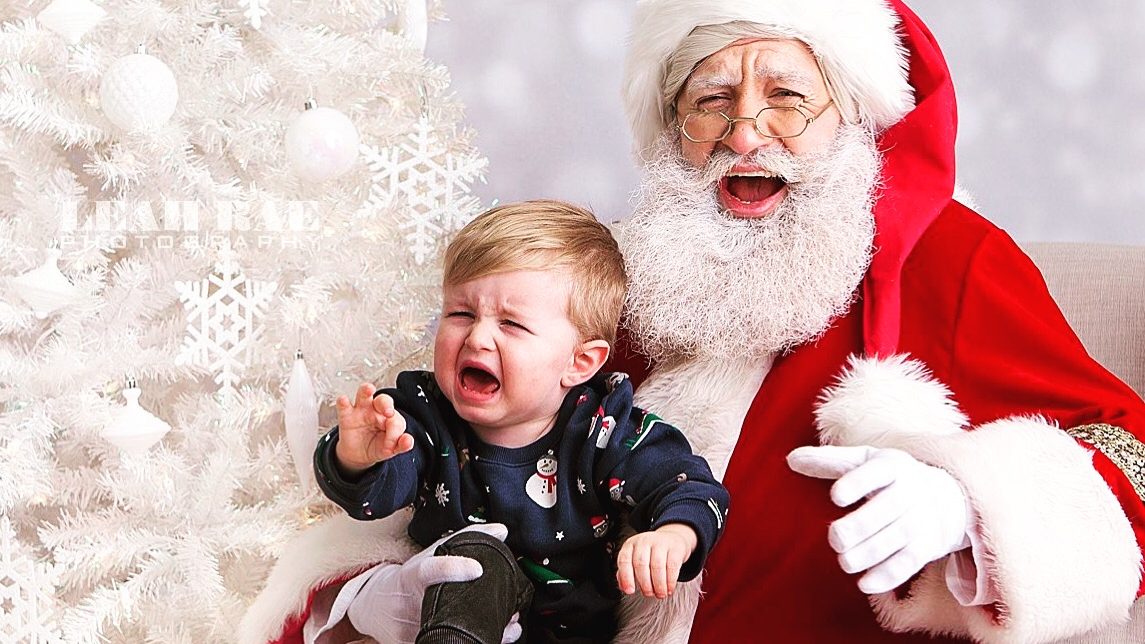
Have you ever seen those photos of crying kids sitting with Santa?
You know the ones I’m talking about, where the child is struggling to get away from Santa, reaching out for a parent with their arms and legs flailing, and looking absolutely terrified and miserable. Did you know that many parents find this funny?
I do not find these photos funny, not in the slightest. And not just because it’s terrible to have a miserable, terrified, flailing child sitting on my lap–it’s mainly because this is TRAUMATIC for the child. Unfortunately, many parents don’t seem to realize this, and think it’s a rite of passage to have a “crying with Santa” photo. It’s not. It’s traumatic for the child, and based on my graduate studies in counseling psychology, I reckon it may be detrimental to a child’s development, along with teaching them a VERY wrong lesson about consent.
Most often, the crying kids in these photos are between the ages of 18 months and 3 years of age, which aligns with Erickson’s psychosocial stages of development model. You see, from birth to about 18 months a child is developing a sense of trust vs. mistrust, and this is the most important periods in a child’s development, it’s the foundation on which their perspective of the world is constructed. So when a child between 18 months and 3 years of age comes to see Santa around the holidays, they’ve got an understanding of who is in their trusted inner circle and who is a stranger–which is likely why children seem to develop a sense of “stranger danger” around 18 months. And while Santa seems like a kind and gentle character they may be familiar with, he’s not a part of their trusted inner circle, he’s a stranger. And by 18 months old a child has learned, hopefully, that it’s not okay to sit in a stranger’s lap.
After 12 years of portraying Santa Claus, I’ve had MANY parents force their child to sit with/on me despite their child being frightened and upset to be placed in the lap of a stranger without the child’s consent. Some parents even try to sneakily place a child onto my lap without the child noticing what’s happening. In these cases, the child almost always freaks out when they turn their head and see my big white beard and red fur-trimmed suit, and I don’t blame the child for this in the slightest–but rather, attribute it to the parent’s lack of understanding of developmental stages. That’s why I’m sharing this message today, because sharing is caring. And like Dr. Seuss said, “Unless someone like you cares a whole lot, nothing’s going to get better, it’s not.”
This brings us to Erickson’s 2nd stage of psychosocial development, Autonomy vs. Shame and Doubt, which occurs from the age of 18 months to 3 years, and marks a time in a child’s life when they’re starting to gain independence and make some decisions about what they do and do not like. And when parents allow their children to make choices and exercise some control, the child begins to develop a healthy sense of autonomy. But when a child is not allowed to exercise some control, they may doubt their own ability to make decisions and develop a sense of shame and helplessness.
This is the crux of my issue with the “crying with Santa” photo that so many parents mistakenly believe is either funny or a rite of passage. When a parent disregards a child’s ability to decide for themselves whether they feel comfortable and safe sitting with Santa, who is a stranger in a strange environment, the child is taught that 1) they don’t have control over their choices and preferences, and 2) they are not given the choice to consent or decline based on how this experience makes them feel.
My own children are 8 and 10 years old, and since before they could speak I have asked them if I can give them a hug or kiss them on the head, and as a result they have developed a strong sense of autonomy and boundaries regarding their bodies. We live in a time when there are very real concerns about consent and ensuring that all persons are given an opportunity to consent to what happens to them and their body.
I believe wholeheartedly that lessons about consent are ongoing rather than a one-time teaching, and this coming holiday season, if you’re planning to take your child to see Santa, I urge you to consider allowing your child to have the opportunity to consent to sitting with him, or not.
Kindly,
Chris “Kringle” MacDonald
p.s. if your child does NOT want to sit with Santa, you can prepare for this by being ready to join the photo with your child. And sometimes, when a child and parent sit with Santa together for a few minutes, this provides an opportunity for transfer of attachment, and the child may feel comfortable sitting with Santa by themselves, so long as their parent stays close by.
#parenting #santaclaus #development #mentalhealth #consent #children #santa #education #christmas2024
 Kindred Consulting: Family and Parent Support & Teen Life Coach